
Designing Experience
- Jess Holzwarth

- Jul 18, 2021
- 4 min read
Create a service or a product with a strong logo and identity that connect elements to people´s emotions, that all in all defines the User Experience.

Source Foto: Apple.com
"From the Gestalt-Bauhaus to Steve Jobs-Apple, one idea only: Be different and Creative, Holistic and Relevant when you need to design and connect that product with people: The result, only can be one, Experience Design".
From the German verb gestalten (to form, to give form, body, to structure, to trace) and that does not have exact translation to the Spanish, it is the Psychological School formed in the middle of the 19th century by the German scientists Wertheimer, Koffka and Kohler, only qualified thus by historians since in a beginning it was only seen as current, means of study.
According to Saíz, Anguera, Molla, de la Casa: "Gestalt the form or figure of a thing, the way it is conformed, or configured in the sense of placement or distribution of its parts and the resulting appearance of that formation" (2011). It means that something or someone is formed by means of its aspects, of its parts to create a whole, which will be observed from that appearance. In the same way it indicates us that "it is a scientific psychology, the object of study is the human conscience by means of the experience, the mental processes, the conscious events" (Saíz, 2011).
In short, it is an empiricist current, its analysis is in the observable, in what is perceived through the senses creates an emotion connecting that product that translates into an experience.
Inspiration in design is a playful concept that eludes any attempt to be caught, it is elusive and very ephemeral. Sometimes all you have to do is listen to a specific song, or look at something and you're in the work zone. Other times, seemingly more random things tend to inspire our work.
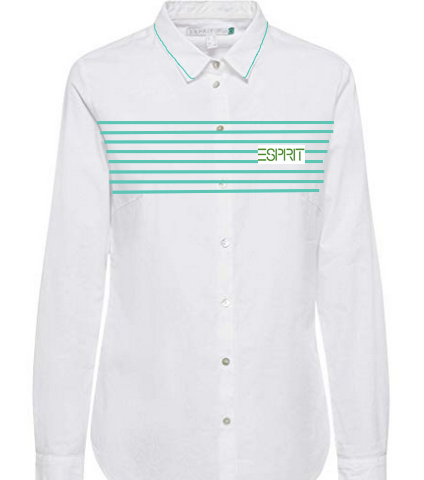
As an example: In my case, this inspiration came from an ESPRIT shirt from 1983. My first salary was to buy that shirt that I still remember with much affection. At that time Esprit was a luxus brand and extremely expensive for a 14 years old girl. But the fascination for the simplicity of the design, the lines, the colours, moves me completely to the point that for me that shirt was unforgetable... It is this simple way of looking at life that has led me to find inspiration in the most varied, diverse and unexpected places. That´s why a Designer can never know from where the magic song of its muse will come from, mine came from an ESPRIT shirt ´83. ;-)



Another definition is given by Jorge Mendoza in his page that talks about therapies through Gestalt. This author tells us that "it is a school of psychology that interprets phenomena as organized, structured units, rather than as aggregates of different sensory data".
Clearly referring to the motto of the Gestaltans "the whole is worth more than the sum of its parts", is therefore required to the perception of the whole, and not the details separately, all is emotion.
The Gestalt is a school that currently to generate awareness of one's ability, according to our own perceptions in the present and remembering it in our memory and how this elements can lead us our decissions.
According to Gestalt: What is Perception?
Perception is a topic of discussion in many universities in the mid-nineteenth century, Gestalt being the one that gave more attention and systematization. For the main authors of Gestalt, it is through perception that will strengthen our learning, memory, thought and others.
Thus, for Gestalt, perception will be defined as "the process of extraction and selection of relevant information in charge of generating a state of clarity and conscious lucidity that allows performance within the greatest possible degree of rationality and coherence with the surrounding world" (Oviedo, 2004).
This author defines it to us like the sensation of a whole before a situation, of which resources will be chosen that could be useful to solve the moment with the greater possible capacity, we will appeal to the memory, and to the power of each one to be sensitive because these data will come from the light, gestures, smells, sound, temperature, etc. Therefore, from these extractions of reality, a mental image will be created in the consciousness. Gestalt appeals to all knowledge a posteriori.
From the book Tabula Rasa by John Locke, there was a greater emphasis on the theme of experience, empiricism had been recognized as a valid knowledge, that knowledge was sustained through the mind, which mixed or united all sensory ideas that appear in the environment and apprehends them, exposed by John Stuart Mill. (Boring, 1992)
Mill says that the mind organizes data, hierarchizes them depending on the situation, generating a single complex data, defined, leaving aside simple ideas such as weight, color to create a single mental state.
From here is based the gestalt motto "everything is worth more than the sum of its parts".
The Form
Starting from what has been said before, the perception of everything is what will give us the data of its complexity.
"We talk about a statue, if we analyse it we will not find anything of quality or slender or beauty, we will only find colors, that this fact or the way it was created, but in its totality it is still beautiful" (Gondra, 1996).
And that is what gestalt perception wants to achieve, qualities according to its totality and thus become a mental structure.
Wertheimer conducted a study called Phi Phenomenon (1912), which is the sensation of movement by means of light. He placed two rods one on each side and they were turned on at small intervals of time, very quickly creating the illusion that they were moving.

USER EXPERIENCE VERSUS USABILITY
Let´s think in our products and services and the process to study User experience and its usability in tradictional way, Our first approach is by doing a market researching, and explainwith this measure s Business KPI and Brand loyalty etc etc we think that we find out the main point to our user, however the component of User experience in Marekting and not just digital is that answers most of our questions.
User Experience
Value
Minimizing steps & removing roadblocks
Making a task meaningful and valuable
creating emotion /connection
What users feel
Satisfaction
Enjoyment
Pleasure
Fun
Usability
Making a task easy and intuitive
Minimizing steps & removing roadblocks
What user do / How they do it
Effectiviness
Efficiency
Learnability




Comments